


Colleges and universities are places of innovation, research and social transformation - but when it comes to climate protection, universities sometimes lack data, structures or action plans. We have accompanied some universities in their climate protection efforts. We would like to report on one of our projects here: How the Technical University of Nuremberg (UTN), newly founded in 2021, together with us and our cooperation partner Analyse HSE an integrated climate protection concept (here available for download) for the university.
What was there before? And what was the result after the project? We look at a before and after comparison in this blog article.
Contents
- BEFORE: Climate protection as a founding principle
- Our process for the climate protection concept
- AFTER: The results and added value of the climate protection concept
- Conclusion
BEFORE: Climate protection as a founding principle of the university
The Technical University of Nuremberg (UTN), the first new state university to be founded in Bavaria in over 40 years, is currently being completely rebuilt. With the ambition of becoming a leading international tech university for AI, robotics and engineering in the future, the university was also Sustainability and climate protection from the outset Founding principle.
Due to the new foundation, the initial situation was as follows:
- No historical databasefor emissions and consumption and therefore no Greenhouse gas balanceas a starting point
- Heterogeneous Stakeholderswith very different requirements
- No existing sustainability or climate protection strategy,but a concrete idea to firmly anchor sustainability and climate protection in the university
The advantage: unlike established universities, UTN did not have to dismantle any legacy issues. Instead, we were able to integrate strategic decisions from the outset in such a way that theA new climate-friendly campus.
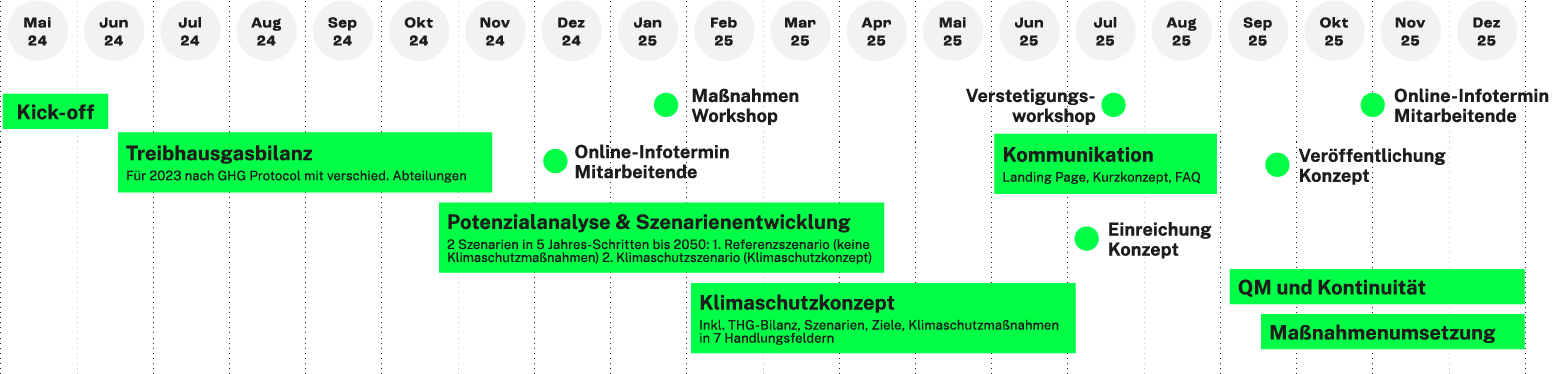
The joint process for an integrated climate protection concept at colleges and universities: Example UTN
Aim of the project
As a sustainability consultancy with expertise in the university environment and our partner Analyse HSE with many years of experience in projects on the topics of energy efficiency and Environmental protection we supported UTN from the initial idea to the adoption of the climate protection concept and the first implementation steps. Our aim was to work with UTN to develop a climate protection concept that Scientifically sound,Participatory developmentandPractically realisableis. AClimate protection concept, which creates planning security for the UTN and serves as a model for other colleges and universities.
The Concept based on a greenhouse gas balance according to the internationally recognised standard Greenhouse Gas Protocol, a potential analysis and a Scenario calculation up to 2050 and the climate protection concept itself, including targets and measures and was adopted by the Executive Committee on 5 June 2025 and approved by the Funding body BMWK accepted with the award „of the highest quality“.
Broad stakeholder participation in the climate protection concept
And how did that work out so well? How did we go about developing the integrated climate protection concept together with the university?
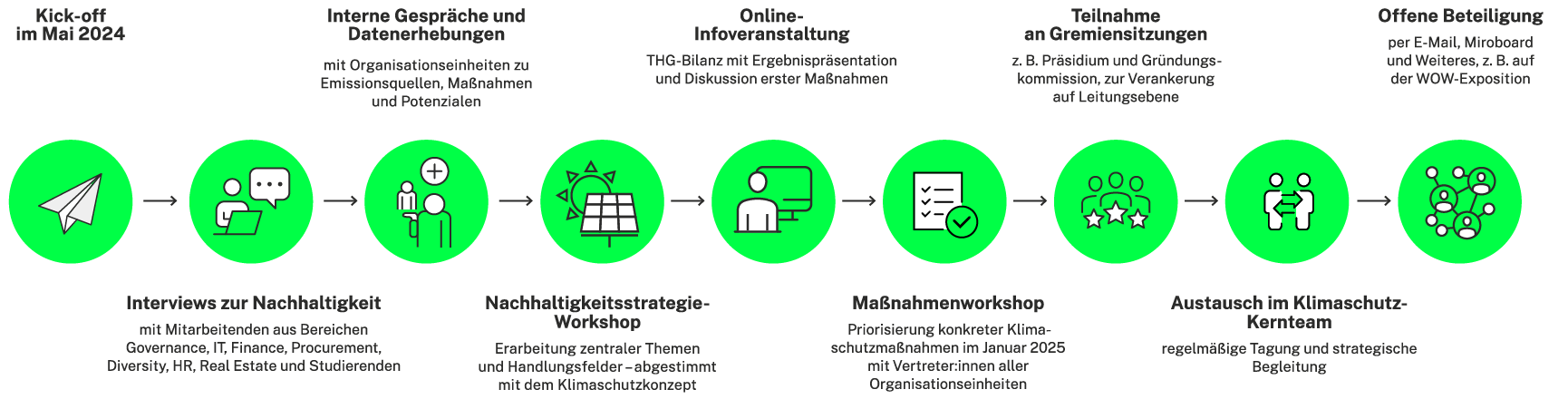
First things first: climate protection can only succeed together. That is why we haveStakeholders involved. This includes university management, such as the Presidential Board, students, chairs, staff and the Building Department, as well as funding bodies.
Together with the UTN, we are acomprehensive participation processfor the development of the climate protection concept, including:
- InteractiveWorkshopswith faculties, administration and technology
- Online info appointmentsfor broad integration
- Accompaniment ofPresidium appointments, to ensure support at management level
Preparation of the greenhouse gas balance
In collaboration with various specialist departments and other stakeholders, we have developed theFirst greenhouse gas balance (also known as a GHG balance sheet or CO2 balance sheet) for the university. This is the basis for making emissions visible and measurable.
We have calculated the greenhouse gas balance in accordance with the international standardGreenhouse Gas Protocol in an Excel toolfor 2023, taking into account all relevant greenhouse gases (these are also known as CO2 equivalents or CO₂e - Read more about the 3 steps to a carbon footprint here).
The Result:
- 259 tonnes of CO₂e total emissions
- 2.2 tonnes of CO₂e per university member/m
- 87 % Scope 3, 13 % Scope 2, 0 % Scope 1

Identifying the largest sources of emissions is important for the development of climate protection concepts at universities. The largestHot Spotswe have identified for the year 2023:
- Mobility (53 %)- especially commuting distances for students and staff
- Procurement (30 %)- especially IT and furniture
- Operation (15 %)- especially heat
- Construction (2 %)- Currently low, growing importance in the future
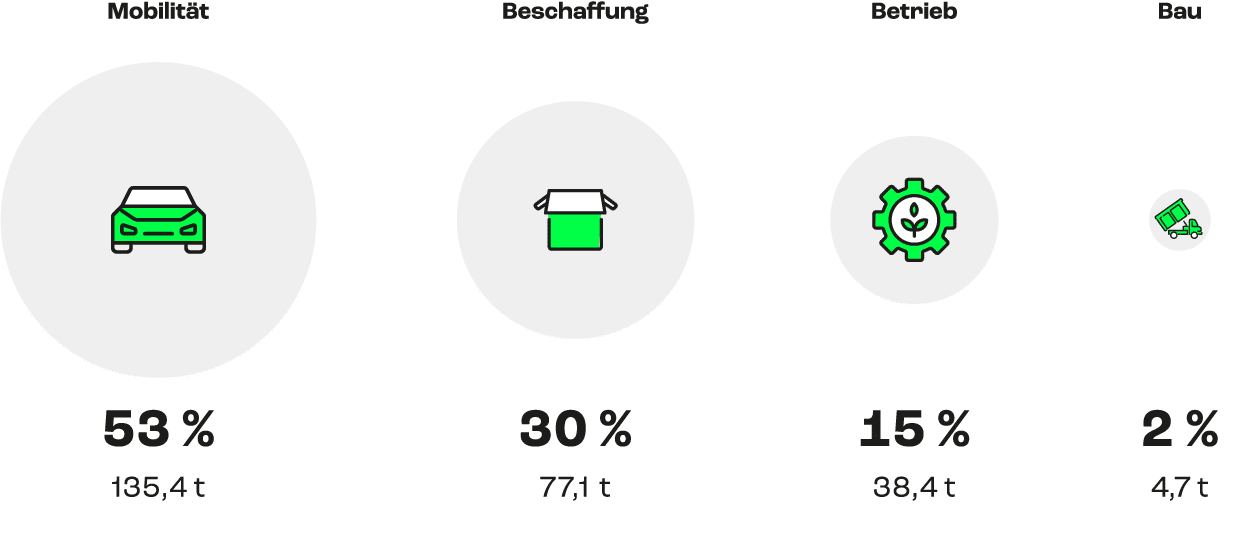
What is exciting here is that we expect these hot spots to shift in subsequent years. For example, we expect thatthe construction divisionwill become significantly more relevant with the ongoing construction of buildings and outdoor facilities from 2024, as will theMobilityThe number of students is increasing due to the establishment of professorships and an increase in student numbers. Alsoeventsin the context of teaching and research, such as guest lectures or research conferences, could emerge as a new hot spot in the future.

Are you planning the next steps towards sustainability?
Ask me for a free information meeting.
I am ready with advice and pleasure.
Franziska Kramer
Sustainability strategy and reporting topics
Two scenarios for the GHG balance by 2050
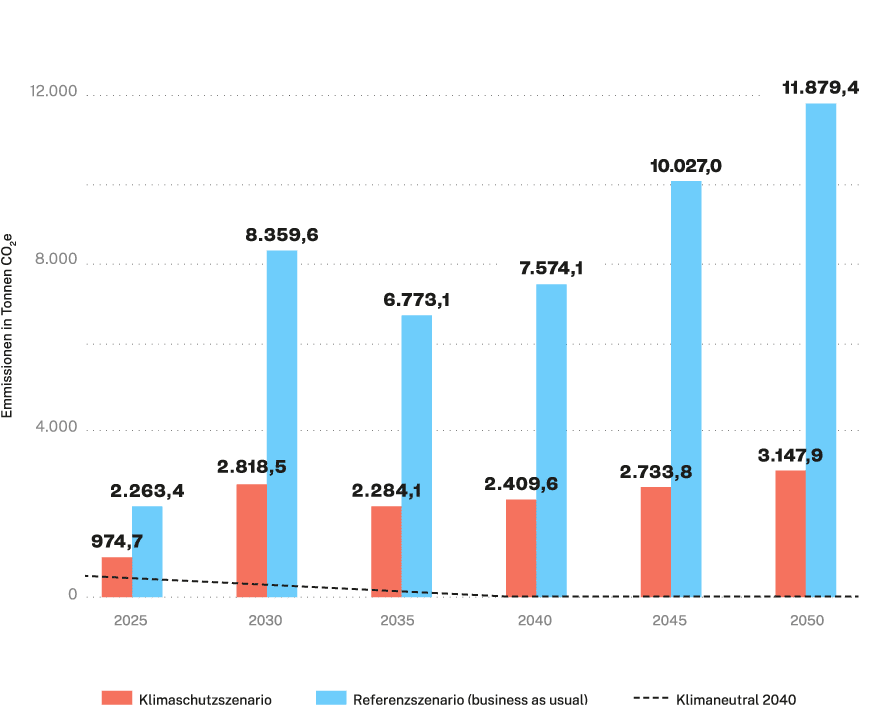
Because we expect changes in the GHG balance in subsequent years as a result of the new campus building and the like, we took a look into the future: How will UTN's emissions develop in the coming decades? What will happen without climate protection? And what with?
For the UTN we haveTwo future scenarios modelled. They show the development of the GHG balance in 5-year increments up to 2050. This allows us to estimate potential emissions in the future for the following scenarios:
- Reference scenarioDevelopment without a climate protection concept
- Climate protection scenario: Development with climate protection concept
The scenario calculation made it clear that with decisive action and strategic planning, the university can avoid its emissions from the outset, while without climate protection measures, existing buildings are built up that are difficult to transform afterwards, especially once the buildings have been constructed.
Climate protection concept of the university with goals and measures in 7 fields of action
The UTN has made a clear commitment to the climate protection scenario with the two Targets: Net zero emissions in Scope 1 & 2 from 2028andGreenhouse gas neutrality across all scopes by 2040 at the latest. To make these goals tangible, we have broken them down into further goals and measures for seven fields of action:
- Procurement
- Operation
- IT
- Campus infrastructure
- Renewable energies
- Space management
- Mobility
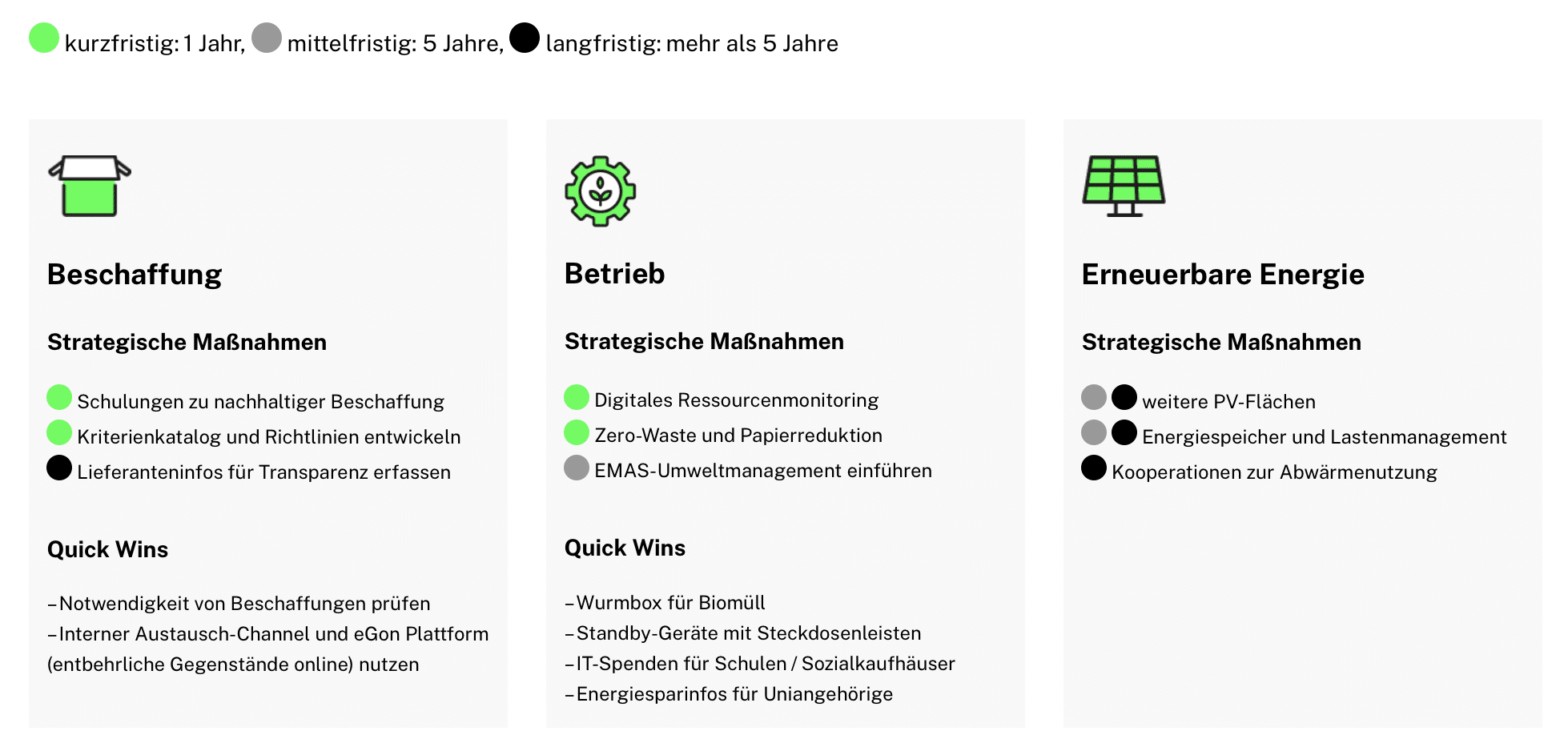
Special feature: In addition toQuick Wins(e.g. worm bin for organic waste) were availableStrategic measuresThe focus is on preventive measures - in other wordsAvoiding emissions before they occur. For each measure we have clearResponsibilitiesstored and suitableIndicatorsdeveloped to make these measurable. We finalised the measures in several participation formats with UTN stakeholders. The picture shows a brief overview of the measures in three fields of action.
AFTER: Results and added value of the climate protection concept for the university
Results of the university's climate protection concept at a glance
In June 2025, the UTN Executive Board adopted the climate protection concept. This strategic roadmap will certainly not disappear into a drawer, as we have made provisions for the continuation of climate protection efforts together with the most important stakeholders.
The Main results of the project at a glance:
- Calculation of CO2e emissions in the GHG balance for 2023
- Provision of aopen Excel tools for the annual GHG accounting, with which UTN will be able to continue its GHG balance independently and autonomously in the future (Here you can read more about 8 CO2 calculators for companies and organisations in comparison),
- Calculation of future emissions in Two scenarios
- Integrated climate protection conceptas a framework for action and strategic guideline for the UTN internally and externally with the Target net zero in Scope 1 & 2 from 2028 and Greenhouse gas neutrality across all scopes by 2040 at the latest
- Clearer Action planwith quick wins and strategic measures
- Broad backingthrough intensive Participation
- Visibility and communication internally and externallythrough website and short concept
- Planning security and independencethrough established processes and structures
- Recommendations for action for regular review and further developmentof the climate protection concept
As a result, UTN not only gains planning security, but alsoPolitical visibilityand establishes itself asPioneer in climate protection at universities.
Added value of the climate protection concept for stakeholders
AClimate protection conceptfor a college or university is far more than just a strategic document. It has an impact on everyone associated with the university:
- For studentsA green, future-orientated campus as a highly attractive learning and research environment. Climate protection can be experienced and creates identification today and for future generations.
- For employeesOrientation and transparency in everyday working life as well as an environment in which climate protection can be implemented and co-designed.
- For the university itselfA strategic roadmap that not only reduces emissions, but also saves costs, promotes innovation and strengthens the political visibility of the university.
- For society and the region: The UTN becomes theInnovation driver in climate protectionandPioneer for impulses in science, business and politics.
This creates joint added value:Climate protection becomes a driver for innovation, attractiveness and responsibility- on and off campus.
Conclusion
The project at the UTN is an impressive example:An effective climate protection concept for a college or university can be developed in a short space of time, even without existing data and without existing „legacy issues“.The decisive factor is the combination ofclear data basis, scenarios, broad participation and practical measures.
For the UTN, this meansLiving climate protection concept, which has not only been decided, but has been lived from the outset and can serve as an example for universities throughout Germany.
Further information
Methods and best practice for sustainability in your mailbox